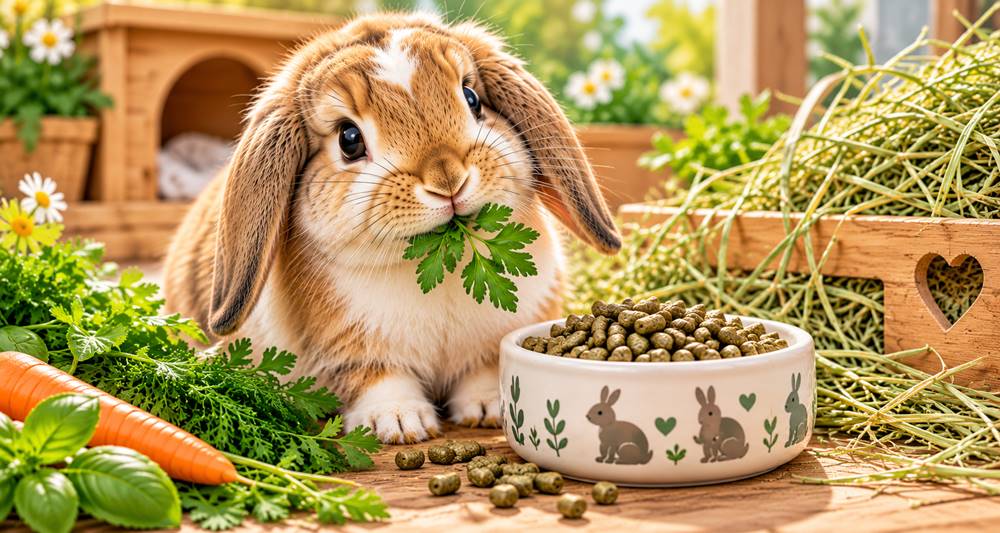
If you share your home with a rabbit, you’ve probably noticed the wide variety of rabbit foods available in pet shops. Different ingredients, colourful packaging and plenty of promises can make choosing the right product confusing.
But how do you know which pellets are suitable for your rabbit? And more importantly, how much should your little companion eat each day?
Rabbit pellets can complement a balanced diet, but they should not be the main source of food for most healthy adult rabbits.
That important role belongs to good-quality hay, which should always be available.
Let’s explore how pellets fit into a rabbit’s diet and what to look for when choosing them.
What Are Rabbit Pellets and Why Are They Important?
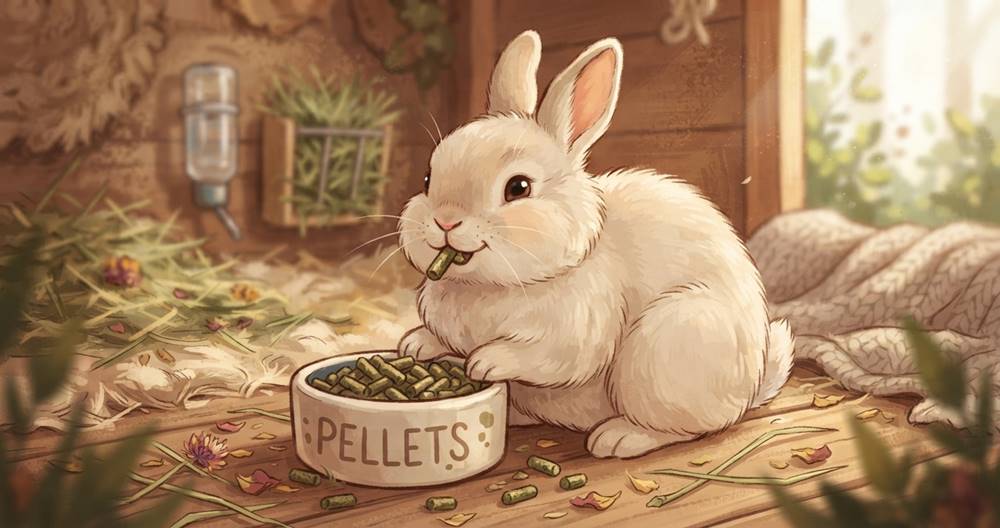
Pellets are compressed food formulated to provide specific nutrients.
Depending on their composition, they contain fibre, protein, vitamins and minerals.
High-quality pellets can help meet a rabbit’s nutritional requirements, particularly when chosen according to age, body condition and individual needs.
However, pellets should never replace hay and suitable fresh leafy greens.
Do All Rabbits Need Pellets?
Not necessarily. Rabbits have different nutritional requirements depending on their age, health and physiological condition.
Some healthy adult rabbits can meet their nutritional needs without pellets when their overall diet is carefully balanced.
Nevertheless, a measured portion of good-quality pellets is often a practical way to provide additional nutrients.
Growing, pregnant, nursing or underweight rabbits may require different formulations and feeding amounts.
In these cases, individual guidance from a rabbit-experienced veterinarian is recommended.
How Many Pellets Should a Rabbit Eat Daily?
The appropriate amount depends on body weight, age, body condition, activity level and the nutritional composition of the pellets.
Some rabbit-care guidelines suggest an approximate upper limit of 25 grams of pellets per kilogram of body weight per day for healthy adult rabbits.
Rabbit’s Weight | Indicative Upper Amount
1 kg | 25 g
2 kg | 50 g
3 kg | 75 g
4 kg | 100 g
These figures are not mandatory feeding targets.
Many adult rabbits need smaller amounts, depending on their overall diet and the product’s nutritional density.
Always consider the manufacturer’s feeding instructions and monitor your rabbit’s body condition.
How to Choose High-Quality Rabbit Pellets
The first step is to read the food label carefully.
Look for:
- Uniform pellets without colourful extras.
- A high-fibre formulation.
- A suitable grass-based ingredient profile for your rabbit’s age.
- Clearly listed ingredients and nutritional analysis.
- Food specifically formulated for rabbits.
For many healthy adult rabbits, Timothy hay-based pellets are a common and suitable choice.
Alfalfa-based pellets have a different nutritional profile and are more commonly used for growing rabbits or animals with specific nutritional needs.
Why Should You Avoid Colourful Rabbit Food Mixes?
Some commercial rabbit foods contain seeds, corn, cereal flakes and colourful pieces.
These products are commonly known as muesli-style rabbit mixes.
They are not recommended because rabbits may selectively eat their favourite ingredients and leave the rest behind.
This selective feeding behaviour can contribute to nutritional imbalances, digestive problems and dental health issues.
Uniform pellets are generally a better option.
What Happens If Your Rabbit Eats Too Many Pellets?
Feeding excessive amounts of pellets can reduce your rabbit’s hay consumption.
As a result, your rabbit may eat fewer long-strand fibres, which are essential for healthy digestive function and normal tooth wear.
Overfeeding pellets may also contribute to weight gain and obesity.
That’s why continuously refilling the pellet bowl is not recommended for most healthy adult rabbits, even when they seem eager for more!
How to Change Rabbit Pellets Safely
Changing your rabbit’s food should be a gradual process.
Start by mixing a small amount of the new pellets with the familiar food.
Slowly increase the proportion of the new product while reducing the old one.
The transition may take approximately two to four weeks, depending on your rabbit and its previous diet.
During this period, monitor:
- Appetite.
- Hay consumption.
- Droppings.
- General behaviour.
If your rabbit stops eating or produces significantly fewer droppings, seek veterinary advice immediately. These changes may indicate a serious problem requiring urgent attention.
Frequently Asked Questions (FAQ)
- Can rabbits eat only pellets?
No. Rabbits need a diet based primarily on unlimited good-quality hay or suitable grass, along with fresh water and appropriate leafy greens.
- Should rabbits have unlimited access to pellets?
For most healthy adult rabbits, measured daily portions are preferable to unlimited access.
- Are Timothy hay pellets better for rabbits?
Timothy-based pellets are often a good choice for adult rabbits, provided the overall nutritional formulation is appropriate.
- Can I suddenly switch rabbit pellet brands?
A sudden change is not recommended. Gradual transitions help reduce the risk of digestive disturbances.
- Why does my rabbit prefer pellets over hay?
Pellets may be more appealing because of their taste and texture. However, a rabbit that consistently avoids hay should also be checked for possible health problems, especially dental issues.
PetFoodHarmony Tip
Don’t judge your rabbit’s diet by how quickly the food bowl becomes empty!
A rabbit that loves pellets doesn’t necessarily need a larger portion.
Measure the daily amount, monitor body weight and condition, and make sure good-quality hay is always available.
Because when it comes to rabbit nutrition, balance matters more than a full bowl!

Θα χαρώ να διαβάσω τα σχόλιά σας